“Storms clear away what’s unsustainable. For those who understand the patterns and prepare accordingly, they don’t just survive what comes next. They build something extraordinary from it.”
In 1992, Hurricane Andrew made landfall south of Miami. The forecasts had been tracking it for days. The warnings were loud and clear. But the people who evacuated and the people who stayed had access to the same information. The difference wasn’t knowledge. It was what they chose to do with it. I’ve spent thirty years studying the financial cycles that create exactly that kind of moment — the slow build, the visible warnings, the critical window where preparation either happens or it doesn’t. We are in that window right now.
I’ve thought about that asymmetry for thirty years. And I keep coming back to it now, because we are living through a version of that moment again. Not a weather event. Something slower, broader, and in many ways more consequential.
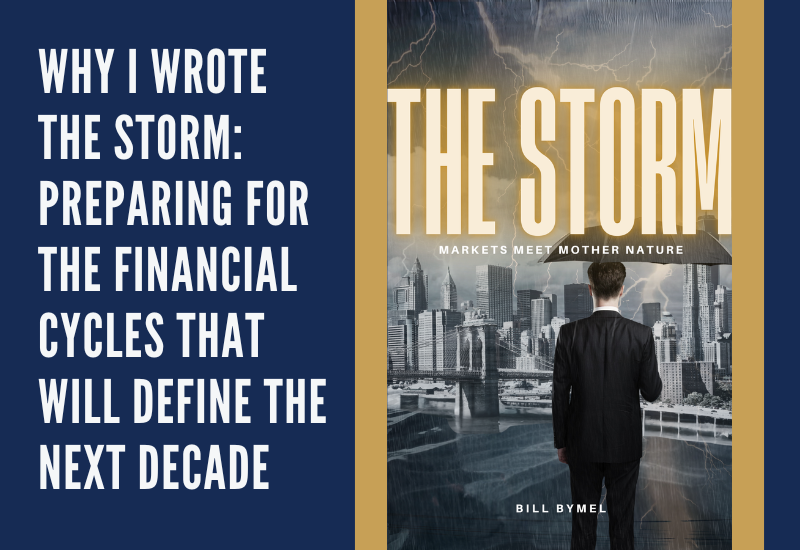
That’s why I wrote The Storm: Markets Meet Mother Nature.
Three forces. One convergence.
The book is built around a simple but urgent premise: three powerful forces are converging simultaneously, and people — and institutions — are responding the way those neighbors in ’92 responded. They see the warnings. They acknowledge the risks. And then they convince themselves it won’t be that bad.
The first force is economic — massive debt loads coming due at the end of a prolonged period of cheap money. The second is societal — dramatic paradigm shifts accelerated by a pandemic and an aging population reshaping how we work, live, and invest. The third is environmental — the increasingly undeniable reality of climate volatility and the financial exposure it creates for real estate, infrastructure, and the institutions built around them.
Independently, each of these forces is significant. Together, they amplify one another the way warm water fuels a hurricane. That amplification is what most forecasts miss and what The Storm is specifically designed to address.
Why I needed to write it — not just say it.
For years I’ve shared these ideas through the Debt Doctor podcast, through conversations at conferences, through the work we do every day at First Lien Capital. And I meant every word. But there’s something a podcast episode can’t do. It can’t hold the full weight of what I’m trying to say. It can’t give you the history, the framework, and the road map in one place, in a way you can return to.
A book forces you to commit. You can’t hedge. You have to say: this is what I believe, this is what the evidence shows, and I’m putting my name on it. Writing The Storm was that act of commitment for me — not as a prediction, but as a responsibility to the community I’ve been part of for three decades.
The people in real estate, debt markets, and banking who read this — you are exactly who this book is for. Not because you’re in danger. Because you’re the ones your clients and colleagues are going to turn to when the ground shifts. I want you ready.
Preparation is not pessimism.
Let me be clear about what this book is not. It is not a doom forecast. It is not a prediction that everything falls apart. History doesn’t work that way — and neither does The Storm.
The Romans built aqueducts and roads — and still crumbled. Kodak dominated photography for a century — until digital killed it. The British Empire’s sun set. These aren’t cautionary tales about failure. They’re reminders that everything moves in cycles, and that the people who thrive through transitions are always the ones who saw the shift coming and made a choice — the same choice those neighbors in Miami made in ’92.
Why now.
The Storm releases this Friday, April 24th. And the honest answer to “why now” is simply this: the convergence I’ve been watching build for years is no longer on the horizon. It’s underway. The window for preparation is open — but it won’t stay open indefinitely.
If you’ve been following this series, you already know the framework. The book is where it all comes together — the history, the patterns, the practical road map for navigating what’s ahead.
In this episode of the Debt Doctor podcast I share the full story behind why I wrote the book and what I think it means specifically for our industry.
The Storm: Markets Meet Mother Nature explores in more detail how these dynamics are starting to reshape credit and real estate markets.
This book and its concepts are drawn from decades of work across real estate, mortgage portfolios, distressed debt, and special assets — with one goal: to provide a clear framework for understanding how these forces are converging, and how to navigate what comes next.
Pre-order now with incredible bonuses at Amazon https://a.co/d/0gPB0yrY.
PRE-ORDER BONUSES (Email your receipt to kalyani@billbymel.com)
• 1-9 books: Chapter 1 of the Audible version.
• 10+ books: 60-minute Private Group Briefing – Navigating the Next Market Cycle: What Convergence Means for Investors, Lenders, and Operators
BUY NOW AT AMAZON: https://a.co/d/0gPB0yrY
Catch you in my next insights,
– Bill Bymel, Debt Doctor
As always, I’d love to hear your thoughts, feedback, or questions.
I also encourage you to share this post with fellow investors who are as passionate as you are about transforming distressed mortgage debt into profitable opportunities.
First Lien Capital specializes in distressed debt and mortgage workout strategies on residential and commercial real estate. First Lien Resolutions provides Special Assets expertise to banks and funds on portfolio risk, recovery strategies, and profitable arbitrage.
Schedule a consultation with Bill to REVIVE your portfolio today.
Stay connected with Bill Bymel: https://linktr.ee/billbymel