“We spent years calling them thousand-year events. We never asked what they’d do to us once they started showing up every year.”
Nobody wants to talk about climate change and real estate in the same breath, so let me be the one to do it.
Line up the last few years of extreme weather and those labels start to fall apart. Quakes, heat domes, wildfires jumping highways, floods that won’t drain for weeks, volcanoes, super typhoons breaking records they set a season earlier.
We called these things “once a century” and “thousand-year” to keep them at arm’s length. Stacked back to back, those labels read like a joke nobody meant to tell. And every one of them has a price tag that eventually finds its way to whoever owns the building.
Something shifted around 2020 and hasn’t shifted back.
Call it the boiling pot.
Sit in the water day to day and nothing feels wrong. Step out, look at the count, and the temperature is impossible to argue with. The events didn’t only get more frequent, they got larger, and they quit taking turns.
Here’s what trips up anyone with money in property: the reflex is to picture the disaster.
The roof.
The flood line.
The claim.
That reflex is aimed at the wrong thing.
The physical event is loud, rare, and insurable.
But what about the simple cost of protecting the asset at all. Insurance is where the weather turns into a number on your statement.
In the exposed markets, premiums aren’t drifting up, they’re doubling and tripling, and in the worst fire and flood corridors carriers are packing up and leaving. When covering a building costs three times what it did, or when no one will cover it, that building’s value gets pulled into a conversation with reality it can’t win.
The next buyer prices in the new number and offers less. A loan that looked clean at closing looks different at renewal. And the assumption underneath most real estate — that you can always refinance your way out — is a lot less true today.
A premium that used to be a rounding error now decides whether a property changes hands at all. That pressure never stays with the owner writing the check. It travels to the value, to the lender holding the note, to the operator watching income thin from a cost that used to be background noise.
And insurance is only one current. Financing is another. Demand is another. Climate change is the one everyone names, but it stopped moving alone. These forces used to run on separate tracks, and now they stack, one on top of the next, right onto whoever’s holding the asset.
Climate change keeps getting shoved into a political box and argued like a belief — tree huggers on one side, capitalists on the other. We’re the only country on Earth that does that.
The Netherlands and Japan spent a hundred years building their societies around Mother Nature while we argued about whether she was real.
What I won’t hand you in a blog post is the part that decides who comes out ahead, how close some already sit to their own tipping point, and roughly when the calm breaks.
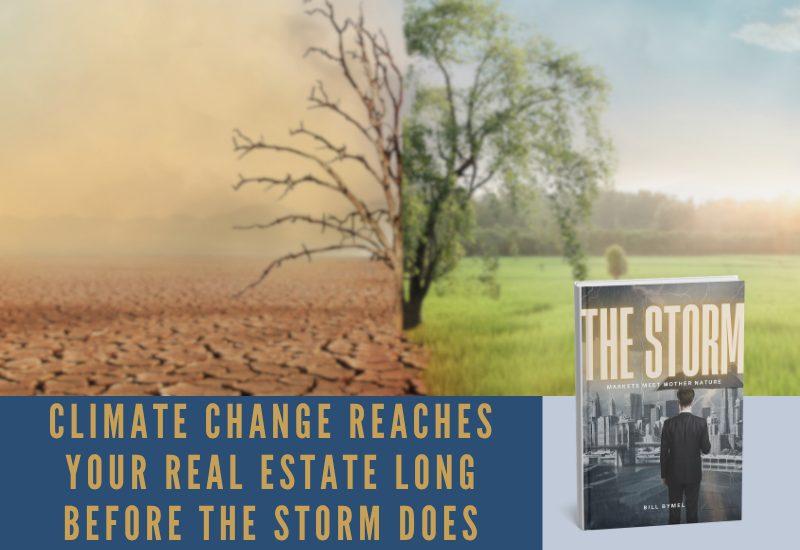
Climate is one current. Debt is another. Where these forces meet, and whose ground gives first is what you’ll read about in greater depth in my latest book, The Storm: Markets Meet Mother Nature.
And I have much more to say about it all in this episode of the Debt Doctor podcast.
The Storm: Markets Meet Mother Nature has received critical acclaim since release in April 2026, opening the conversation of how converging forces are reshaping markets and offering the framework for investors and institutions to navigate what comes next. Available at Amazon and other major retailers https://a.co/d/0gPB0yrY.
Reviews say: “The Storm is not just a book, it’s a strategic lens into the future of our industry.”
Subscribe to Debt Doctor on Apple, Spotify, YouTube or your favorite podcast platform.
Catch you in my next insights,
– Bill Bymel, Debt Doctor
As always, I’d love to hear your thoughts, feedback, or questions about this topic, episode, the market or the industry.
If someone in your network needs to read this, send it their way.
First Lien Capital is a privately owned distressed mortgage investment platform focused on the acquisition and timely resolution of sub-performing, non-performing mortgage loans on residential or commercial real estate.
First Lien Resolutions, First Lien Capital’s third-party advisory and special servicing arm for banks, funds, and institutions holding distressed and dislocated debt, delivers end-to-end resolution through engineered outcomes that work for investors, servicers, and borrowers.
Whether you’re a bank, servicer, hedge fund, family office, or institutional investor, let’s talk about what our RESOLUTIONS can do for your book.
Stay connected with Bill Bymel: https://linktr.ee/billbymel