Why Deals Don’t Pencil Anymore
- All Posts
- Asset Evaluation
- Asset Management and Servicing
- Coffee with Bill
- Commercial Real Estate
- Debt Doctor
- Due Diligence
- Financing and Funding
- Industry News and Updates
- Investment Strategies
- Market Analysis and Trends
- Mortgage Note Investing
- Networking and Partnerships
- Press
- Private Credit
- PropTech
- Real Estate Lowdown
- Real Estate Owned
- Secondary Mortgage Market
- Success Stories and Case Studies
- The Storm
- Win-Win Webinar
While values held, the cost of fixing and carrying the asset has exploded.
“Nothing makes sense. Everything is a sh*t show.”
That’s a direct quote from an experienced investment banker who trades loans and real estate portfolios in the secondary market. He sits between private credit funds, institutional investors, lenders and operators, and he sees more bid tapes in a month than most people see in a career.
I’ve been hearing versions of this for months. Sellers can’t understand why the bids come in where they did. Buyers can’t understand why the sellers won’t move. Every model on both sides of that desk says the trade should work, yet the trade doesn’t happen.
What’s most interesting in my recent experience is that house flipping costs, not values, are driving the problem. Values have primarily held in single family. While there are plenty of markets pulling back in value, especially those boosted by Covid migrations, our modelled valuation target is not the reason deals fail today.
In a fix-and-flip residential strategy, including HECM estate properties that require probate and foreclosure, the after-repair values we underwrote two and three years ago have mostly aligned. Changes have taken place everywhere between the purchase and the resale: the cost to get the house to that value, and the cost to hold it while you do. The expense stack has moved on every line, and it moved hardest on the lines impacted most by older, vacant house with deferred maintenance.
The Rehab Cost Stack
From a macro perspective, we all know that inflation has been prolific the last five years, but here are actual statistics on how house flipping costs have moved in just the past three.
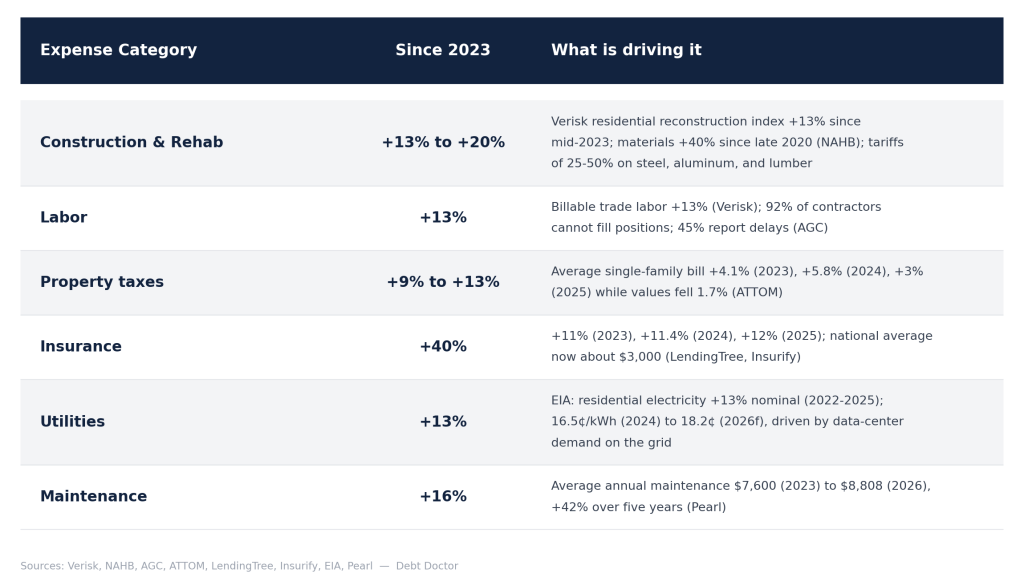
Construction and rehab. The index is up 13% since mid-2023 but our real-world experience says more. Materials are up 40% since late 2020 and the tariffs landed on top: 50% on steel and aluminum, an effective 45% on Canadian lumber, 25% on cabinets and vanities. A standard HECM scope includes roof, HVAC system, electrical panel, a kitchen and baths, and those are all categories that moved. The scope we bid at $60,000 in 2023 comes back at $69,000 today, although heavier scopes are running 20% over or higher.
Labor. Ninety-two percent of contractors can’t fill open positions, and nearly a third have lost workers to immigration enforcement with 45% reporting delays because of it. When the crew shows up late or a job runs long, that’s unbudgeted. The labor problem is a cost problem on two fronts – higher costs and longer timelines.
Property taxes. The average tax bill kept rising through 2025 while average values fell 1.7%. Memphis was up 34% last year, Baltimore 27%, and Houston 10%. Then there’s the vacant-property problem. In Washington, D.C., a house classified vacant is taxed at $5.00 per $100 of assessed value versus the standard millage $0.85 per $100 for occupied. If your vacant property is deemed blighted, then the tax increases to $10.00 per hundred (10% property tax). We are living this on our own D.C. properties.
Insurance. Three straight years of double-digit increases, roughly 40% cumulative, to a national average around $3,000, and that’s for an owner-occupied policy. A vacant-dwelling policy on a sixty-year-old house with an original roof is a different conversation, if you can get a policy written at all. Jefferson Parish, Louisiana, insurance increased 33% in six months recently and Collier County, Florida, up 25% in that same window. For folks that retired to Florida on a fixed income, this sudden shift in the TI portion of PITI can be devastating.
Utilities. Electricity is running ahead of inflation with data centers pulling on the grid and we can expect prices to increase going forward. You keep the power and water on through a rehab, and you keep the heat on through the winter, so the pipes don’t split. Gas prices will likely get worse in the near term. Every month of hold is a utility bill about 15% higher than our model.
Maintenance. The average home now costs $8,808 a year to maintain, up 16% since 2023 and 42% in five years. On a vacant property, maintenance also means lawn, winterization, board-ups, preservation, mechanicals, and security.
The Same Flip, Then and Now
Here’s the workout-guy math on a representative HECM flip. Same house, same after-repair value, same purchase price. Only the cost stack and the hold period change.
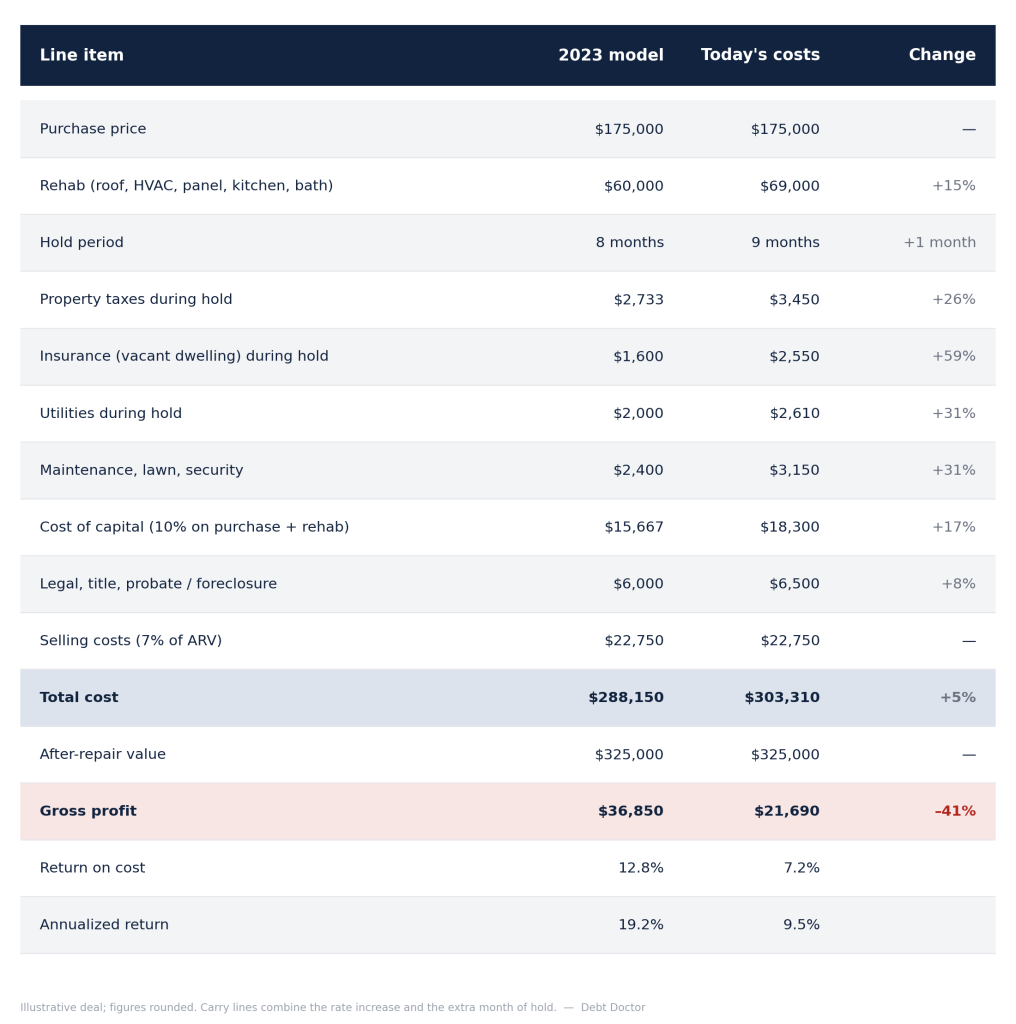
Notice the bottom of that table. Total cost went up 5%, and profit declined 41%. The annualized return was cut in half. Nothing in these figures is dramatic on its own; the rehab line is the biggest mover and it’s only 15%. The deal fails because flipping can be a thin-margin business by design. The profit was 11% of ARV to start, and a 5% move in the cost stack kills it.
ATTOM’s national numbers tell the same story. Gross flip margins hit 25.5% in 2025, the lowest since 2008, down from 32.1% the year before, and the first quarter of this year came in at 25.4%. Flippers failing is an early sign of market dislocation and the precipice of a correction.
Why it feels like a Sh*t Show
Now put yourself on both sides of the trade. To make the same dollar profit on that house today, my bid must drop to about $161,000. To make the same annualized return with the longer hold, it must drop to about $157,000. That’s 8% to 10% off my 2023 bid for the same asset.
The seller, whether it’s a servicer, HUD, an estate, bank, or a fund that bought the loan in 2023, has a reserve that was set off the 2023 model. Their value is my value. They look at my new bid and see a buyer trying to steal the asset. I look at their reserve and see a deal that loses money. Both of us are running a model that is right on the value and wrong on the costs. If you’re the trader sitting in the middle, it’s hard to paint a clear picture with opaque data.
Multiply that by every tape on this market maker’s desk and you get his quote. Nothing clears because nobody agrees on the cost to get from here to there, and the cost keeps moving while you argue about it.
I wrote in The Storm: Markets Meet Mother Nature about what happens when the inputs to a valuation all move together instead of one at a time. A building’s insurance jumping from $40,000 to $120,000 at renewal takes $1.6 million of value off it at a 5% cap rate with nothing physical changed. The residential version is quieter. It’s a 15% rehab overrun, a 40% insurance renewal, a 12% tax bill and an extra 2 months of hold, all landing on the same deal, and none of it showing up on the appraisal.
What to do about it
We re-bid the scope before we bid the asset. A 2023 unit-cost sheet is a liability now. Every scope gets priced by the trades that will do the work, this quarter.
We underwrite carry at today’s renewal. Insurance is quoted as a vacant-dwelling policy on the actual house. Taxes are checked against the jurisdiction’s vacant classification before we own the problem.
We model longer holds. Contractors run late and the resale market is slower. On the example house, every extra month costs about $1,300 in carry before financing.
We walk. If the seller’s reserve is built on a 2023 cost stack, the trade waits. Reserves reset once the holding costs have come out of the seller’s pocket for long enough. That’s when the inventory shows up, and that’s the trade we’re positioned for. We have multiple deals this year where the economics of the deal drop out of favor just in the 2-3 months of diligence we’ve been doing on them. It’s not easy to walk away from deals that you’ve spent thousands of dollars on legal, title, and value. It’s even more difficult to ignore our vested interest, the time myself and my team dedicated to seeing this deal through. Trust your gut and remember you can’t lose chips you don’t put on the table.
Anyone who tells you the problem is values is ignoring the real complexity. House flipping costs, not asset values, are eating away margin, one reasonable-looking increase at a time. Deals still work. Fewer of them make sense.
More soon,
– Bill Bymel, Debt Doctor
As always, I’d love to hear your thoughts, feedback, or questions about this topic, the market or the industry.
If someone in your network needs to read this, send it their way.
For any lender holding defaulted or at-risk loans, the window to recover what’s owed narrows with every missed milestone. Together, First Lien Capital and UCLS now close that gap with one platform to identify, repair, and recover value before it is lost for good.
Lenders and servicers can learn more or request a confidential portfolio review at First Lien Resolutions, the advisory and special servicing arm of First Lien Capital.
Stay connected with Bill Bymel: https://linktr.ee/billbymel

- All Post
- Asset Evaluation
- Asset Management and Servicing
- Coffee with Bill
- Commercial Real Estate
- Debt Doctor
- Due Diligence
- Financing and Funding
- Industry News and Updates
- Investment Strategies
- Market Analysis and Trends
- Mortgage Note Investing
- Networking and Partnerships
- Press
- Private Credit
- PropTech
- Real Estate Lowdown
- Real Estate Owned
- Secondary Mortgage Market
- Success Stories and Case Studies
- The Storm
- Win-Win Webinar