“A serious delinquency isn’t a missed payment. It’s a foreclosure that hasn’t printed yet.”
A steady set of headline numbers is doing a lot of work right now. Delinquency prints look contained, home values are holding, and from the outside the housing market reads calm.
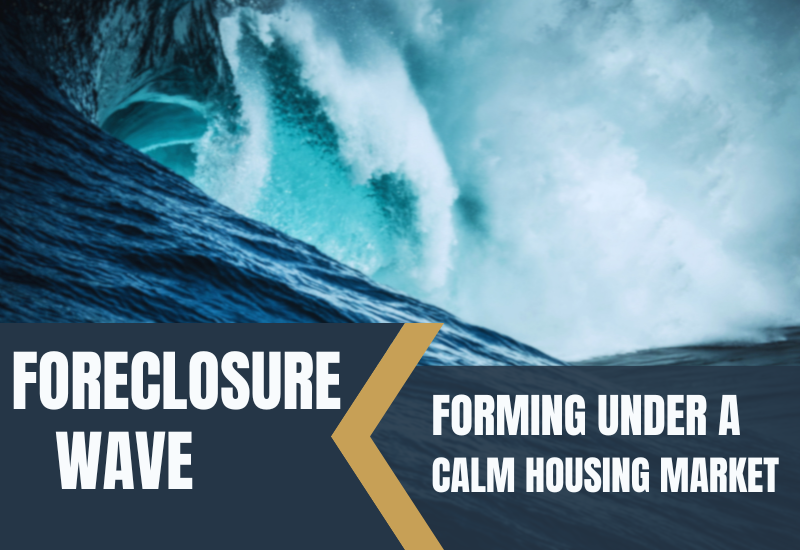
Sit with the underlying data long enough, though, and a foreclosure wave starts to take shape beneath it, one where the calm isn’t strength, it’s a delay.
Start with the loans that were paused rather than paid. Years of forbearance and intervention didn’t erase distress; they rescheduled it. A borrower who stopped paying and was allowed to defer never cured anything, the obligation simply moved down the calendar, and a lot of those dates are arriving together.
FHA and VA books carry a heavy share of that deferred stress, and the delinquency curve on government-backed paper has been bending in a direction the top-line numbers don’t advertise.
Then there’s the quality of the paper itself. A wave of lending over the last cycle was dressed up to look prime while being underwritten like something else entirely — the kind of loan that behaves fine in a rising market and turns fast when it stops rising.
Private credit has ballooned into the space traditional lenders stepped back from, and a lot of that exposure has never been tested through a real downturn.
On paper it looks safe. Probably shouldn’t trust it.
Strategic defaults add the human layer, and this is where a foreclosure wave stops rhyming with the last one.
When a borrower with options runs the math and decides walking away is the rational move, that’s not desperation, it’s a decision. It resets a balance sheet in one stroke, and once it becomes normalized behavior in a segment, it spreads on incentive, not hardship.
Layer on a demographic reality that gets almost no airtime: seniors carrying non-dischargeable student debt into fixed-income retirement, an obligation that doesn’t forgive and doesn’t flex, pressing on households already stretched by affordability.
Each of these feeds the same drain. Short sales re-emerge as the pressure valve before foreclosure does — quieter, less visible in the data, and a magnet for the kind of fraud that shows up whenever there’s a spread to exploit.
Commercial paper flashes its own warnings.
The flip market, so dependent on cheap, fast capital, runs out of runway the moment that capital gets expensive. From the front, none of it looks like a crisis. That’s what makes this foreclosure wave slower, more distributed, and easier to miss until it’s already moving.
Knowing why a foreclosure wave is forming is one thing. Knowing when it turns and which market it hits first, residential or commercial, which loan type, which region, is not something a spreadsheet hands you.
Drawing on what the NRBA floor was actually saying versus what the headlines are printing, that’s the real scoop Michael Krein and I get into in this episode of the Debt Doctor podcast. Subscribe to Debt Doctor on Apple, Spotify, YouTube or your favorite podcast platform.
The Storm: Markets Meet Mother Nature has received critical acclaim since release in April. It’s available at Amazon and other major retailers: https://a.co/d/0gPB0yrY
The Storm and its concepts are drawn from decades of work across real estate, mortgage portfolios, distressed debt, and special assets to open the conversation of how converging forces are reshaping markets and offering the framework for investors and institutions to navigate what comes next.
Reviews say: “The Storm is not just a book, it’s a strategic lens into the future of our industry.”
Catch you in my next insights,
– Bill Bymel, Debt Doctor
As always, I’d love to hear your thoughts, feedback, or questions about this topic, episode, the market or the industry.
If someone in your network needs to read this, send it their way.
First Lien Capital is a privately owned distressed mortgage investment platform focused on the acquisition and timely resolution of sub-performing, non-performing mortgage loans on residential or commercial real estate.
First Lien Resolutions, First Lien Capital’s third-party advisory and special servicing arm for banks, funds, and institutions holding distressed and dislocated debt, delivers end-to-end resolution through engineered outcomes that work for investors, servicers, and borrowers.
Whether you’re a bank, servicer, hedge fund, family office, or institutional investor, let’s talk about what our RESOLUTIONS can do for your book.
Stay connected with Bill Bymel: https://linktr.ee/billbymel