“The premium you’re paying isn’t for scarcity. It’s for a story.”
The same line keeps being repeated and repeated. There aren’t enough homes.
It shapes how buyers bid, how investors underwrite, and how policy gets written.
There’s only one problem.
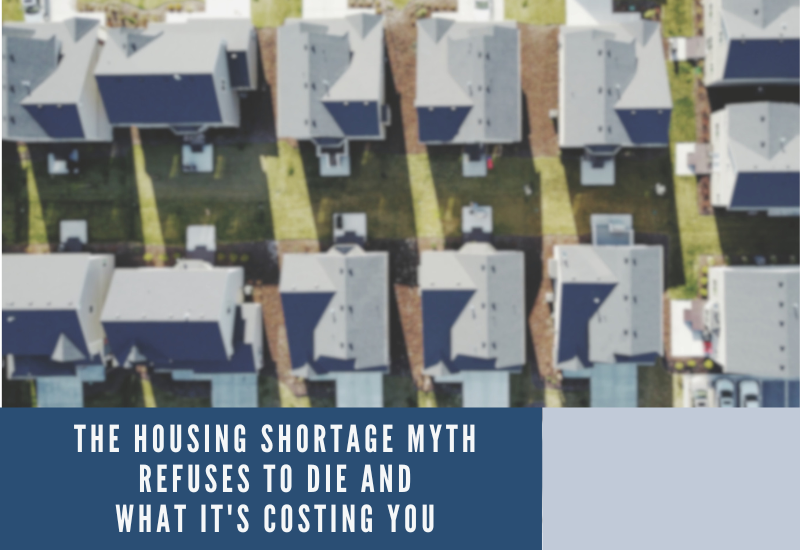
Drive the neighborhoods instead of reading about them, and the housing shortage myth starts coming apart in your hands.
Here’s the part that should land closer to home: every move you make on a house right now is priced against that myth. The premium you’re paying isn’t for scarcity, it’s for a story. Whether you buy, wait, or hold, you’re doing it on a false read of the board, and a false read has a price.
The inventory is there. The trouble is where it sits and what it’s tagged at.
Homes are parked in metros that built for a demand wave that never fully landed, held off-market by owners waiting for a number, or listed at prices no one will transact on.
From a spreadsheet that reads as scarcity. On the ground it reads as misallocation — supply that exists but isn’t pointed at the people who’d actually buy it.
Scarcity and a stalemate look identical in the data and behave nothing alike.
Texas and Houston are the clearest tell. Institutional overbuilding stacked units on the bet that growth would absorb everything. When absorption slows, that math doesn’t bend gently, it snaps. And the repricing won’t stay where the cranes were.
Insurance and climate risk are quietly resetting the cost of ownership coast to coast, dragging carrying costs up in markets that still believe their prices are safe.
Underneath it, the population is turning. Boomer retirements are loosening homes back into the market over time, and the real condition of long-term rentals isn’t the tight, undersupplied picture the narrative leans on.
Stack those forces together and you get a market far more fragile than its headline price suggests.
Then there’s Q4.
A distressed pipeline is building, and the conditions are lining up for values to move faster than the conventional story allows.That’s where the cost stops being abstract.
Buying on the myth means overpaying today for a floor that may not hold. Holding on the myth means betting prices can’t fall, which leaves you most exposed the moment they do. And being young and locked out means being told to stretch now before it gets worse, when the truer danger is buying into the top of a mispricing.
What actually matters is how narrow that window is, and where the opportunity sits when it opens, which isn’t something you read off a chart. It’s a read from people in the field, not the feed.
The investors who come out ahead in the next stretch won’t be the ones chasing a shortage that was never there. They’ll be the ones who priced honestly and knew where to look before the crowd did.
The headlines won’t tell you what the true inventory is. The neighborhoods already are. And every day the myth holds, someone is paying the premium on a shortage that is not real.
If you want the part the data alone won’t give you, Melody Wright laid out her full read on the timing and the specific markets she’s watching in this episode of the Debt Doctor podcast. Subscribe to Debt Doctor on Apple, Spotify, YouTube or your favorite podcast platform.
The Storm: Markets Meet Mother Nature is now officially released and available at Amazon and other major retailers: https://a.co/d/0gPB0yrY
This book and its concepts are drawn from decades of work across real estate, mortgage portfolios, distressed debt, and special assets to open the conversation of how converging forces are reshaping markets and offering the framework for investors and institutions to navigate what comes next.
Reviews say: “The Storm is not just a book, it’s a strategic lens into the future of our industry.”
Catch you in my next insights,
– Bill Bymel, Debt Doctor
As always, I’d love to hear your thoughts, feedback, or questions about this topic, episode, the market or the industry.
If someone in your network needs to read this, send it their way.
First Lien Capital specializes in distressed debt and mortgage workout strategies on residential and commercial real estate. First Lien Resolutions provides Special Assets expertise to banks and funds on portfolio risk, recovery strategies, and profitable arbitrage.
Schedule a consultation with Bill to REVIVE your portfolio today.
Stay connected with Bill Bymel: https://linktr.ee/billbymel